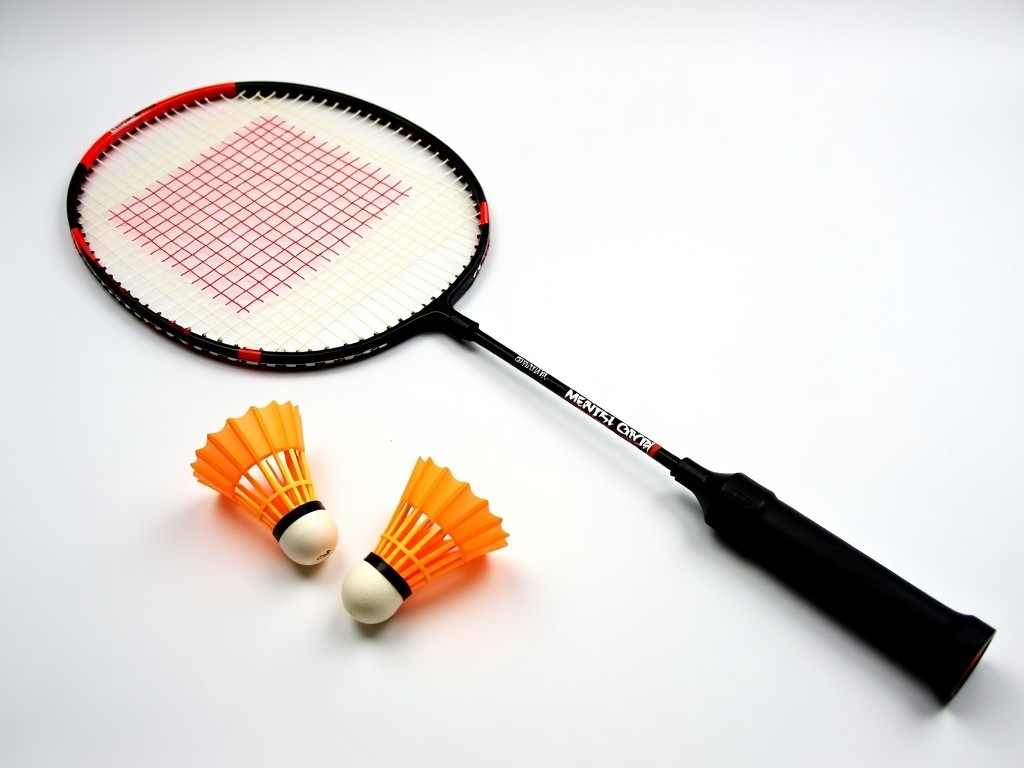
Specifying Low Price badminton racket with shuttlecock set Factory Sale for Wholesale and OEM Orders
The main trade-off in a low-price racket set is frame material versus service life. Aluminum keeps the unit cost down and resists incidental court scraping, but it bends permanently at the throat under repeat loading. Graphite or composite shaves grams and restores shape better, yet costs more per piece and can crack at stress points if the layup is thin. Pairing that frame with nylon shuttlecocks extends playable hours on abrasive outdoor courts, while feather shuttlecocks fly true indoors but split after a few hard smashes. The purchase decision should be set by where the set will be used, not by the lowest headline price.
What Actually Determines Performance
Fatigue appears at the stress concentration where the shaft enters the head, not along the length of the frame. A badminton racket works as a lever: head mass and shaft stiffness set the swing weight, while balance point determines whether the head feels heavy at contact. String tension loads the frame on every impact, and on thin aluminum walls that load can permanently ovalise the head or bend the throat. The shuttlecock half of the set behaves differently—a nylon skirt resists abrasion on outdoor courts but drags more in flight, while a feather skirt cuts through air cleanly yet splits after repeated hard smashes.
A buyer pricing a repeat order should treat balance point and weight tolerance as warranty variables. A batch that ships at 98 g on one order and 106 g on the next changes how the racket feels in the hand, and players log that as a quality problem even when the frame is intact. String tension loss follows the same pattern: if the factory pre-strings at uneven tension, some rackets go dead after a week while others hold for a month. The inspection step that catches this is a per-batch weight and balance check, not a visual glance at the carton.
| Specification | Aluminum-frame set | Graphite-reinforced set |
|---|---|---|
| Frame material | 6061 aluminum alloy tube | Graphite composite with resin matrix |
| Typical unstrung weight | 95–110 g | 85–98 g |
| Balance point from butt | 290–310 mm (head-heavy) | 280–300 mm (even) |
| Recommended string tension | 18–22 lbs | 20–24 lbs |
| Shuttlecock skirt | Nylon | Nylon or duck feather |
| Shuttlecock base | Composite cork | Natural cork composite |
| Service life under club use | 3–6 months before frame retirement | 6–12 months before finish wear |
| Primary fatigue failure | Permanent throat bend after off-centre impact | Crack at the grommet zone or shaft tip |
Matching the Product to the Buyer's Need
School sports programs run rackets through multi-hour daily rotations on concrete and wood courts, so frame durability outranks swing weight in their specification. They also need identical weight across a class set so no student can claim one side is heavier. A club league playing indoors three evenings a week cares more about shuttlecock flight consistency than frame abrasion, because feather or nylon skirts degrade at different rates in still air. The purchasing specification should therefore match the court surface and session volume before it matches the price.
The same specification that suits an indoor academy fails outdoors. Wind shifts the flight of a feather shuttlecock enough to make rallies unplayable, and cold air changes shuttlecock speed so a set rated for summer arrives sluggish in winter. Retail gift sets add another constraint: packaged weight and box dimensions set the freight cost, so a heavier frame and extra shuttlecocks can erase the unit-price advantage. Distributors buying for resale should lock a spec sheet with the factory before the first order, because verbal agreements on string tension or grip size drift the moment production starts.
Buying Mistakes That Lead to Returns
Weight and stiffness trade off against each other, and buyers who ignore the trade-off receive returns. A frame that is too light bends under a strong smash, while a shaft that is too stiff transfers vibration to the wrist and generates comfort complaints after a single session. String tension compounds the problem: tensioning a thin aluminum frame to 24 lbs looks impressive on a spec sheet but invites frame collapse during the first restring. Grommets are the quiet failure point—worn or missing grommets let strings saw through the frame at the throat, which the buyer sees as a structural defect.
- Ordering by unit price alone and skipping a pre-shipment weight check, which lets ±3 g racket drift reach the shelf and generate "heavy side" complaints.
- Pairing a thin aluminum frame with high string tension to impress buyers, then accepting frame ovalisation after the first restring.
- Specifying feather shuttlecocks for outdoor windy courts where the skirt deforms after a few rallies and the base separates on hard impact.
- Accepting mixed grip sizes in one carton, which changes swing feel and triggers warranty claims from consistency-focused accounts.
Each of these mistakes shows up as a return, not a defect report, so the cost lands in the warranty line rather than the purchase price. The cheaper unit is only cheaper until the second shipment arrives.
Segment-Specific Requirements
Institutional buyers such as academies and school boards need batch consistency above all else: twenty rackets in one carton should weigh within a few grams of each other so coaching drills are not skewed by equipment variance. They also need replacement shuttlecocks in sealed tubes that survive warehouse stacking without skirt crush.
Retail gift sets are judged on presentation and perceived completeness. A two-racket set with three shuttlecocks in a printed box must keep the frame finish unscuffed during retail handling, and the shuttlecocks should not rattle loose in transit. The outer carton dimensions and inner dividers become part of the specification because they determine how many units arrive sellable.
Distributors and importers buying under a private label face the freight configuration as a specification item. Rackets shipped strung take more cubic volume and risk string-bed compression in a pallet, while unstrung rackets need a tension recommendation printed on the carton so the retailer can finish them correctly. Batch traceability through lot codes lets the importer recall only the affected production run if a frame batch shows throat cracking.
Quality Control and Batch Consistency
Repeat orders fail when the second batch arrives 5 g heavier than the first and the balance point shifts enough to change swing feel. Factory-side quality control for this product family is dimensional and weight-based: each racket is weighed unstrung, checked for balance on a beam, and rolled on a flat plate to reveal throat or head warp. String tension is verified with a meter on pre-strung samples, and grommets are pull-tested to confirm they will not let strings cut the frame. Shuttlecocks are hit full-court to confirm they land inside the marked service zone for their speed grade.
| Inspection point | Check method | Acceptance limit | Sample frequency |
|---|---|---|---|
| Racket weight (unstrung) | Digital scale | ±3 g of quoted nominal | Every batch |
| Balance point | Balance board | ±10 mm of quoted nominal | Every batch |
| Frame straightness | Roll on flat plate | No visible wobble at throat | First article + 10 pcs per batch |
| String tension (pre-strung) | Tension meter | Within 1 lb of target | 5 pcs per batch |
| Grommet retention | Manual pull test | No pull-out or cracking | 10 pcs per batch |
| Shuttlecock skirt integrity | Visual after 20 smashes | No split or base separation | Every batch |
| Shuttlecock flight | Full-court hit, landing zone | Inside marked service zone | 5 pcs per speed grade |
| Carton drop | Corner and face drop on packed carton | No frame damage | Every shipment |
A lot-code sticker on each carton links the shipment to the weight and balance records, so a warranty claim can be traced back to a production date rather than written off as a batch-wide problem. That traceability is what turns a repeat order into a predictable cost instead of a returns surprise.
Keeping Repeat Orders Supplied
Lead time and MOQ set the ceiling on how quickly a distributor can restock after a selling season. A sample-approval step before production locks the racket weight, string tension, and shuttlecock speed so the bulk run matches the approved unit. Keeping a golden sample in the warehouse gives the receiving team a physical reference for incoming inspection.
Packaging configuration determines how much product survives the journey. Inner carton dividers, bubble wrap around the head, and shrink-wrapped shuttlecock tubes prevent frame scuffing and skirt deformation during sea freight. Buyers should specify whether rackets ship strung or unstrung, because strung sets occupy more volume and compress the string bed if stacked under heavy cartons.
Request a pre-production sample to verify weight tolerance, balance point, and shuttlecock flight against your order specification. Submit a sample request.


