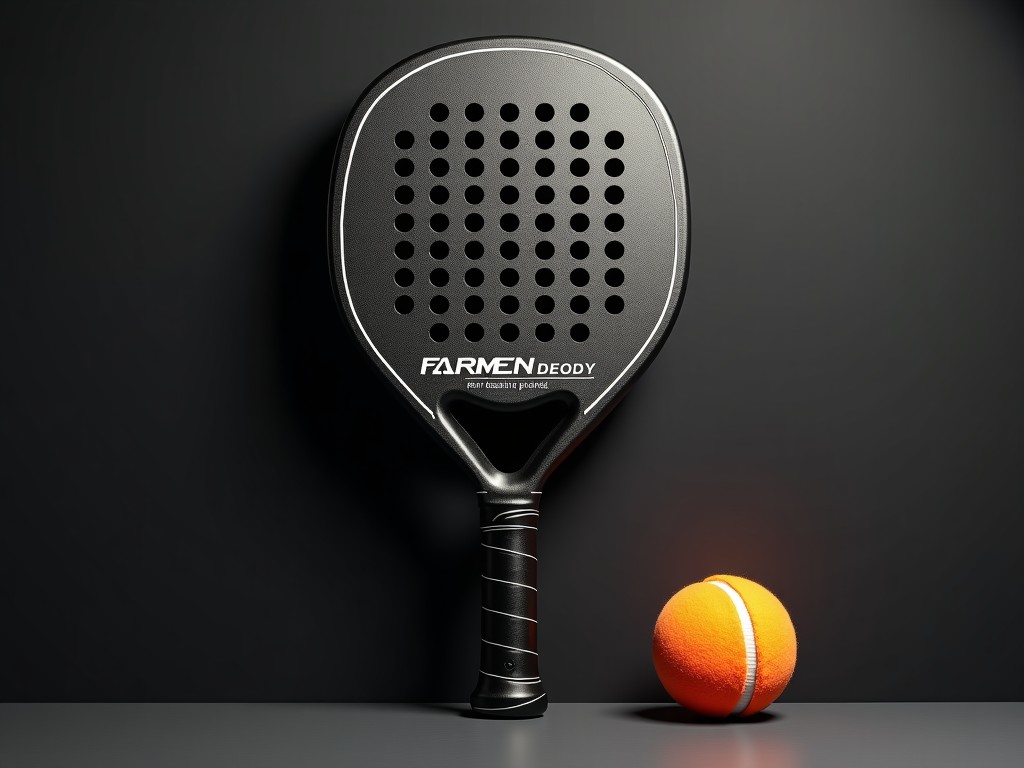
custom durable carbon fiber padel racket pro Company: Specification, Ordering and Quality Notes
Fatigue appears at the stress concentration. High-frequency impact in academy environments leads to micro-fractures in the resin matrix when the layup is inconsistent. Our manufacturing process focuses on structural integrity to prevent delamination over hundreds of play-hour cycles. We prioritize bond-to-fiber ratios to ensure the balance point remains consistent even after repeated contact with the court.
Scope of Supply and Physical Form
Standard production follows the regulated 45cm length and 26cm width profile. We provide rackets with a weight range of 330g to 375g, depending on the density of the internal foam and the specific carbon weave selected. The frame geometry utilizes a reinforced bridge to distribute torque during overhead shots, mitigating the common failure point at the throat of the racket.
- Core thickness options: 35mm for control, 38mm for power-oriented models.
- Surface texture: Sand-finish or matte-rough carbon fiber patterns for spin enhancement.
- Grip specifications: Standard polyurethane with 1.2mm overlap moisture-wicking properties.
Material Options and Their Trade-offs
Weight and stiffness trade off against each other. A 12k carbon fiber weave offers more elasticity, which benefits players seeking a softer feel and increased vibration absorption. Conversely, 18k or 34k weaves increase frame modulus, providing higher power transfer but making the racket more susceptible to brittle cracking if the resin system is not properly cured.
We utilize varying EVA density grades to tune the rebound rate. High-density EVA maintains its shape longer but requires more physical effort to generate speed, whereas lower-density foam provides a "trampoline effect" that may lose properties after prolonged high-impact use.
Measured Performance in Real Use
Repeat loading drives the failure. In outdoor conditions, UV exposure and sweat acidity can degrade the surface resins if the protective coating is insufficient. We apply a multi-layer UV-resistant finish to prevent yellowing of the carbon fiber and to maintain the structural bond of the paint. Abrasion testing ensures that the surface texture does not peel off after friction contact with the ball or the court.
Option Comparison by Usage Level
| Feature | Academy/Entry | Pro/Competitive |
|---|---|---|
| Face Material | Glass Fiber / 12k Carbon | 18k/34k Carbon Fiber |
| Core Density | Soft EVA (Low HR) | Hard EVA (50+ HR) |
| Balance Point | Head-Light | Head-Heavy/Even |
| Durability Rating | High (Impact Resistant) | Medium (Performance Focused) |
Matching the Product to the Buyer's Need
Selecting the right configuration depends on the target user's skill level and the turnover rate of the club or academy.
- If the priority is high-volume rental for beginner students, select the 12k carbon layup with soft EVA to minimize impact-related injury and breakage.
- If developing a retail brand for the top-tier market, utilize the 18k carbon weave with a stiff frame to maximize power output and precision for advanced players.
- For private-label projects seeking a balance of cost and durability, hybrid glass-carbon construction provides a resilient alternative at a lower unit price point.
Assumptions Buyers Should Stop Making
Many buyers assume all carbon fiber rackets are identical. In reality, the weave density (12k, 18k, 34k) fundamentally changes how the racket absorbs energy. Another common misconception is that weight is always better; however, proper distribution of mass (the balance point) is more critical for preventing long-term frame delamination during aggressive lateral play.
Ordering, Tooling and Lead-Time Questions
Tooling for custom molds requires a 30-45 day lead time. For existing mold configurations, production lead times are typically 21-30 days depending on the order volume. We require a MOQ of 50 units per specification set to ensure batch consistency during the curing process.
What is the tolerance for weight variance?
We maintain a weight tolerance of +/- 3 grams across the entire batch. Variations beyond this range indicate inconsistencies in core foam density or carbon layup application.
Can custom branding be applied without affecting the finish?
Custom graphics are applied via heat-transfer or silk printing before the final clear coat. This ensures the branding does not compromise the aerodynamic properties of the racket surface.


