oem pink padel rackets and balls factory: Specification, Ordering and Quality Notes
The complaint that repeats across reorders often involves the delamination of the racket face after three months of high-impact play. When the balance ratio varies beyond +/- 3 grams, the frame fatigue accelerates under repeated impact vibration. Consistency in the core foam density is what determines whether a racket maintains its power output or becomes dead within the first season.
Returns usually trace back to the same weak point: the throat of the racket where stress concentration is highest. If the resin-to-fiber ratio is not uniform, the structural integrity develops micro-cracks that lead to catastrophic failure. We focus on the mechanical properties of the layup to ensure that the balance point remains static across the entire production run.
Design Constraints Behind the Specification
High-concentration pink pigments in the surface resins can alter the chemical bond between the carbon fiber and the foam core. If the curing cycle is not adjusted for these specific additives, the face may peel under thermal expansion. We utilize a vacuum-pressure curing process to ensure the aesthetic finish does not compromise the structural bond of the frame.
Material Interaction Trade-offs
A thicker beam width (typically 38mm for standard padel) increases the sweet spot but raises the swing weight. For players seeking maneuverability, a thinner profile allows for faster reaction times, but requires a higher-modulus carbon weave to prevent torsional instability off-center hits.
Specification Range and Customisation Limits
The choice between EVA foam and Foam core significantly dictates the "feel" of the racket. Soft EVA provides more vibration absorption for comfort but loses energy faster than Hard EVA, which maximizes power return. We provide specific density ratings in kg/m³ to ensure the racket matches the target player's skill level.
| Feature | Available Options | Performance Impact |
|---|---|---|
| Face Material | 3K, 6K, 12K Carbon Fiber | Stiffness and surface friction |
| Core Density | Soft, Medium, Hard EVA | Power rebound and vibration damping |
| Ball Material | Synthetic Rubber, Nylon | Durability and flight consistency |
How to Choose Before Requesting a Quote
Weight distribution is the most critical metric for retail buyers. A racket balanced at 360g is generally categorized for advanced players, while a 340g head-heavy setup targets recreational power players. We define the weight tolerance at +/- 2 grams to ensure every unit in a shipping container functions identically.
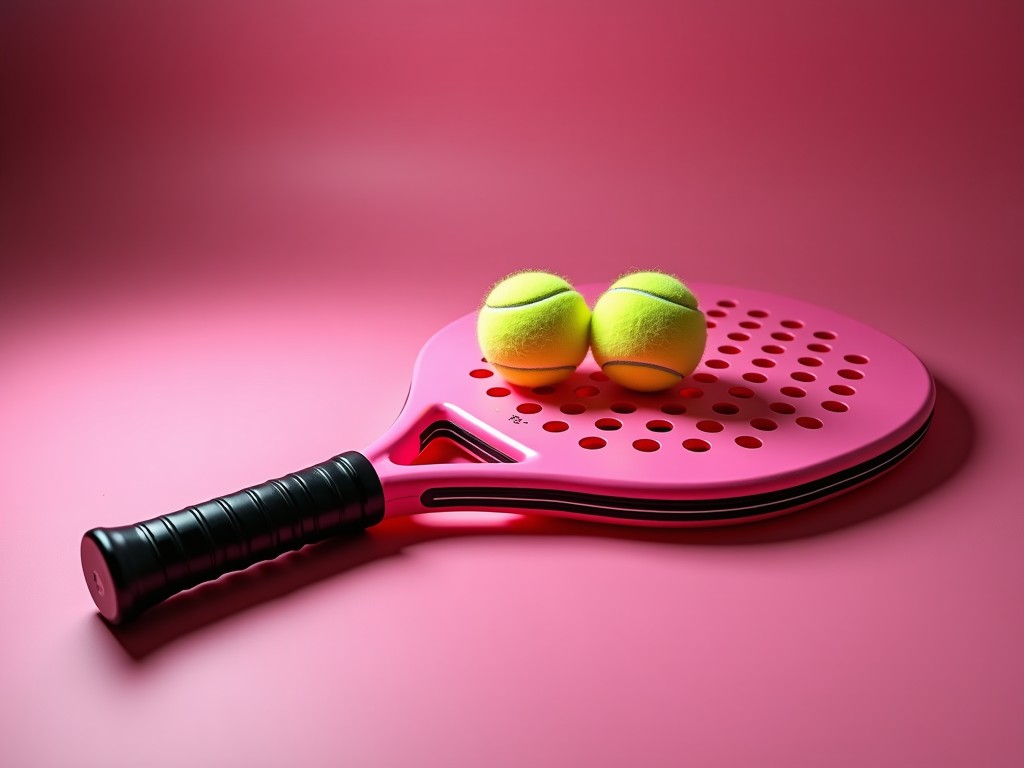
For ball production, the seam construction is the primary point of failure. Heat-bonded seams are preferred to prevent the ball from decompressing under high-velocity impacts, which is a common complaint for balls used in high-frequency training environments.
OEM and ODM Programme Structure
Our OEM process begins with a technical drawing that defines the frame geometry and hole pattern density. This prevents structural weaknesses during the injection-molding phase. Once the digital file is approved, we produce a pre-production sample to verify the balance point and surface texture feedback.
- Technical CAD approval and structural tolerance mapping.
- Color-matching protocols for pink-specific resins.
- Physical prototype testing for weight-distribution-verification.
Quality Control and Batch Consistency
Batch consistency is maintained through randomized sampling of every production run. We test the rebound height of padel balls to ensure they all fall within the 5% tolerance window. This eliminates the risk of a distributor receiving a shipment where some balls perform differently than others.
| Usage Condition | Potential Failure | Preventative Specification |
|---|---|---|
| High-velocity impact | Core delamination | Reinforced edge guard TPU molding |
| UV exposure | Surface fading | UV-stabilized resin coating |
| Repeated compression | Pressure loss | High-density rubber bladder specification |
Ordering, Tooling and Lead-Time Questions
Tooling for custom racket shapes requires a 4 to 6 week lead time for CNC steel mold creation. This investment ensures that the frame geometry remains consistent across thousands of units. Standard mold orders typically follow a 30-day production cycle, depending on raw material availability for specific carbon weaves or foams.


