china carbon fiber pickleball manufacturer - Bulk Supply and Specification Guide
Scope of Supply and Physical Form
| Parameter | Standard Range | Customization Options |
|---|---|---|
| Face Dimensions | 16.5" x 7.5" (US Standard) | Aerodynamic shapes, elongated heads |
| Total Weight | 7.5oz - 8.5oz | Target weight within +/- 1g tolerance |
| Core Thickness | 13mm, 16mm | Polypropylene honeycomb, foam-infused |
| Surface Material | T700 Carbon Fiber | Carbon weave, hybrid carbon-fiberglass |
Cost and durability pull in opposite directions once high-frequency play cycles become the primary performance metric for wholesale buyers. For private-label brands, the structural integrity of the paddle depends on the bond strength between the carbon fiber face-layers and the polymer honeycomb core. Our manufacturing process focuses on vacuum-pressing these layers to eliminate air pockets, which are the leading cause of premature paddle delamination in high-impact scenarios.
Where chlorine, sweat or UV exposure is routine, the degradation of the epoxy resins and the adhesive holding the edge guard becomes a factor. We utilize UV-stabilized resins to ensure that the paddle stiffness does not drop or become brittle after several months of outdoor court exposure.
What Actually Determines Performance
The performance of a carbon fiber paddle is dictated by the relationship between swing weight and the coefficient of restitution. A thinner 13mm core provides higher power output but increases the vibration transfer, potentially making the paddle less forgiving for recreational players. Conversely, a 16mm core increases energy absorption, providing better control but requiring a higher-grade carbon fiber layup to maintain a competitive weight profile.
Technical Consistency Note
Weight variance across a batch of 1,000 units is maintained within +/- 2 grams. Deviations beyond this range usually indicate inconsistent core density or uneven resin distribution, which affects the balance point and increases return rates for the end distributor.
Surface friction, often referred to as grit, is critical for spin generation. Raw carbon fiber offers a natural texture, but friction-coated or grit-textured weaves determine how long the paddle maintains its performance. We test the abrasion resistance to ensure the surface friction remains effective for a minimum of 50 hours of competitive play.
Materials and Construction Trade-offs
T700 Carbon Weave
Provides the highest stiffness-to-weight ratio. Ideal for professional-level paddles requiring maximum power transfer and torsional stability.
- Higher material cost per unit
- Exceptional resistance to deforming forces
- Stiffer "feel" compared to glass-fiber hybrids
Fiberglass/Hybrid
Offers a more flexible face with softer "pop." Better suited for entry-level markets where price sensitivity is the primary driver.
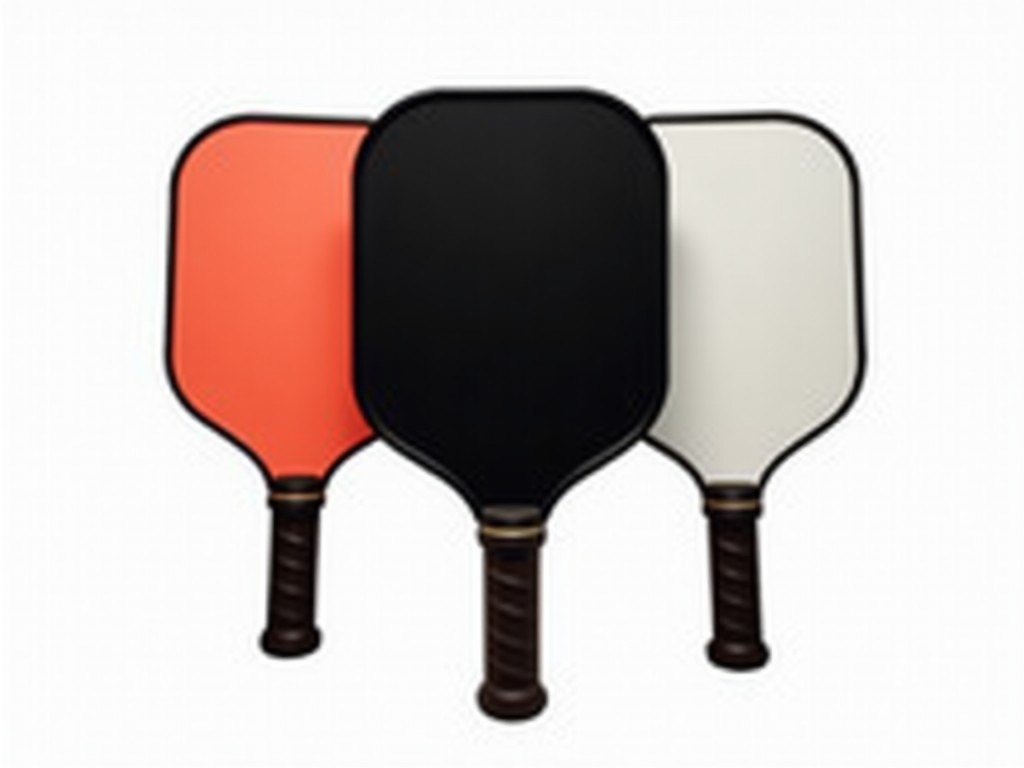
- Lower production overhead
- More forgiving on off-center hits
- Prone to faster fatigue over long cycles
Specification Range and Customisation Limits
Material choice starts with the conditions the product will meet. If a brand targets the tournament-grade market, a multi-layered carbon fiber construction is non-negotiable. For mass retail, a hybrid construction with a fiberglass face allows for better margins. We offer custom molding for the surface texture, ranging from thermoformed molded patterns to spray-applied high-friction grit finishes.
Customization is also limited by the physical properties of the core. While we can accommodate various grip sizes and edge guard colors, the core geometry must remain consistent with the mold design to ensure structural integrity at the paddle neck.
OEM and ODM Structure
Our OEM program allows wholesale buyers to select existing high-grade molds and apply custom branding via silk-screening or UV printing. This minimizes lead time and eliminates tooling costs. For brands seeking a unique geometry, our ODM service involves the development of bespoke steel molds specifically engineered for the carbon fiber layup.
Minimum order quantities for custom molds typically start at 500 units per SKU to amortize the cost of the tooling. Standard-mold designs qualify for lower MOQs, providing flexibility for brands testing new production cycles.
Inspection Items and Test Methods
| Test Parameter | Methodology | Accept Criteria |
|---|---|---|
| Weight Variance | Digital scale measurement per unit | +/- 2g from target specification |
| Delamination Resistance | High-impact drop test | No visible separation or core cracking |
| Surface Abrasion | Standardized abrasion wheel | Retention of friction coefficient > 70% |
| Torsional Stability | Torque application | No permanent deformation under load |
Capacity, Tooling and Scheduling
Production capacity is scaled by the curing time of the carbon fiber-impregnated layers. We can process up to 10,000 units per month for standard configurations. For custom molds, the tooling phase requires approximately 4 to 6 weeks, which includes CNC machining of the aluminum molds and initial sample validation for dimensional accuracy.
Lead times for repeat orders are significantly reduced once tooling amortisation is complete. Typically, production from order placement to shipping-ready takes 30 to 45 days depending on the volume and raw material availability.
Stock Availability and Reorder Planning
To avoid stockouts, we recommend a reorder cycle that triggers 60 days before current inventory depletion. This buffer accounts for international freight lead times and ensures that the specific T700 carbon fiber batches does not disrupt the supply chain for your retail partners.


