China half court pickleball nets manufacturer - Bulk Supply and Specification Guide
Consistency is set at the forming stage. For half-court training equipment, the tension stability of the mesh and the tensile strength of the top band determine the service life in high-frequency academy environments. A high-density polyethylene (HDPE) mesh with a 40mm weave maintains its shape after 1,000 impact cycles, whereas lower-grade nylon alternatives often deform under the kinetic energy of a pickleball.
Materials and Construction Trade-offs
| Option | Technical Specification | Performance Metric | Primary Benefit |
|---|---|---|---|
| Mesh Material | UV-stabilized HDPE (12 gauge) | 98% UV resistance rating | Outdoor-grade longevity |
| Top Band | Vinyl-coated steel wire | 15kg tensile strength | Zero-sag center profile |
| Tape Construction | Double-knitted reinforced polyester | 30mm width tolerance | Impact resistance |
Technical Note: For half-court specifications, the mesh-to-tape width ratio is critical. A tighter weave reduces wind resistance, which keeps ball trajectories consistent during high-velocity training drills.
Measured Performance in Real Use
The build method decides how the net reacts to thermal expansion. In outdoor settings with temperature fluctuations, standard polyester tapes stretch, leading to a loss of the required net height. We utilize a pre-shrunk weave process that limits dimensional drift to less than 2% across a range of -10°C to 45°C.
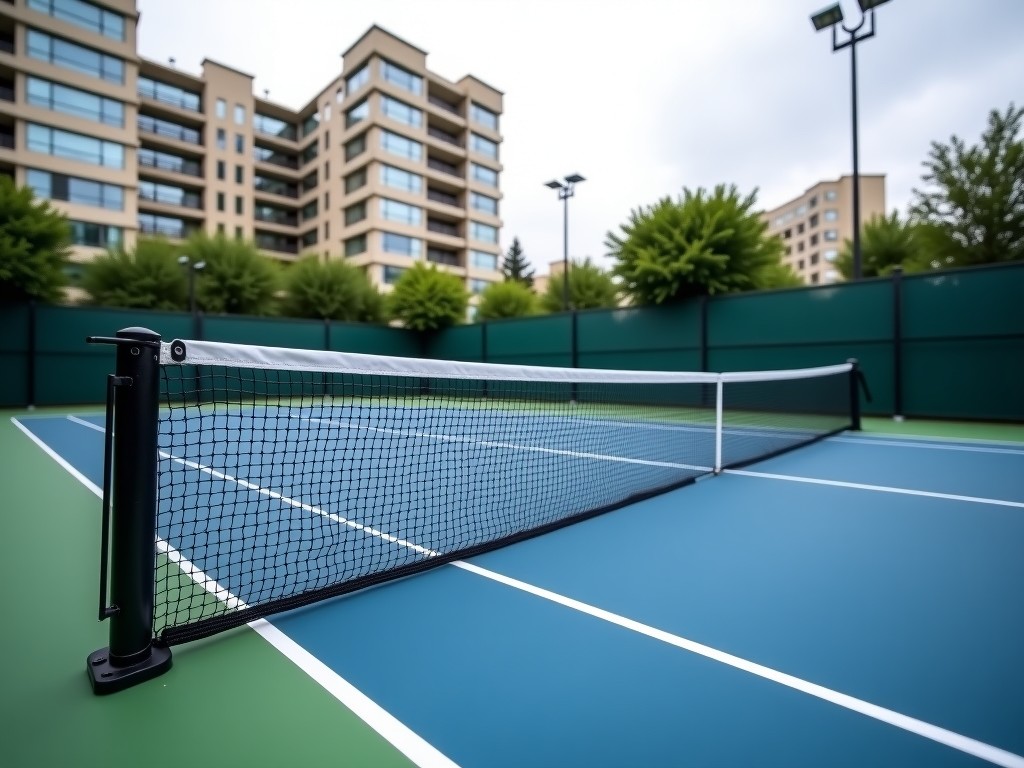
Standard Grade
- Single-layer mesh construction
- Basic UV-stabilization
- Suitable for indoor-only academy use
Professional Grade
- Double-density HDPE mesh
- High-molecular UV stabilizers
- Designed for 2+ season outdoor exposure
Buying Mistakes That Lead to Returns
Procurement officers often overlook the gauge of the internal wire. If the wire is too thin, the tension required for half-court setups causes the top band to kink after the first month of seasonal installation. This results in an inconsistent ball bounce that frustrates professional-level training sessions.
Another common failure point is the lack of de-rating information for UV exposure. Without specified stabilizers, the mesh fibers become brittle within six months of direct sunlight, leading to mesh tearing upon ball-impact. Buyers should verify the technical material data sheets before approving bulk production runs.
Usage Scenarios and Buyer Segments
Academies utilize half-court nets for specific drills like dinking and rapid-reaction vol. In these scenarios, the net must withstand frequent setup and teardown cycles. The reinforced eyelets are necessary to prevent abrasion at the attachment points.
Distributors targeting retail-ready kits require consistent color batches and standardized packaging. For these segments, the manufacturing focus shifts to color-fastness testing and the durability of the retail-grade packaging to ensure zero-damage arrival of individual units.
Volume Planning and Lead Time
Production cycles are dictated by the mesh-weaving loom capacity. For bulk orders exceeding 2,000 units, the standard lead time is 35 to 45 days. This includes the procurement of raw UV-stabilized resins and the final tension-testing phase.
Smaller-scale orders can often be fulfilled from stock components, but custom-color tapes or specific mesh widths require an additional 14-day window for dye-lot matching and sample-approval.
Export Packaging and Handling Protection
To prevent moisture ingress during sea freight, each net is wrapped in a 60-micron poly bag. These are then packed into corrugated fiber boxes that withstand a crush test rating (ECT) of at least 32. This ensures the mesh is not compressed or creased during long-term container storage.
Need to verify technical tolerances for your academy launch?
Request a technical sample and quote

