custom portable outdoor pickleball nets on wheels Company: What Buyers Should Check Before Ordering
Deflection under load governs the net height consistency during high-intensity play. If the frame lacks sufficient lateral rigidity, the center of the net sags under ball impact, leading to inconsistent bounce results. Purchasing managers must prioritize heavy-gauge steel tubing to maintain the required 36-inch height at the center across the entire span. This structural integrity prevents the "dip" common in lower-cost aluminum alternatives.
The Problem Buyers Keep Paying For
Standard retail-grade units often fail at the tensioning point because they utilize simple cord-based systems. When the mesh stretches due to humidity or heat, the net loses profile, requiring frequent manual adjustments that disrupt tournament schedules. Furthermore, low-grade casters frequently lock up or shear when exposed to outdoor grit and moisture. These failure modes result in high return rates for distributors and replacement costs for club operators who expect equipment to survive 12-hour daily-daily-use cycles.
What the Design Has to Balance
The interface between parts like the caster assembly determines the unit's stability on uneven asphalt surfaces. A heavier base prevents tipping in windy conditions but increases freight costs and physical strain for club staff. We utilize a weighted ballast-base design to keep the center of gravity low while keeping the total unit weight under 25kg. This balance ensures the net remains portable for one person while remaining anchored during high-velocity play.
Material Specification
Our frames utilize 30mm square-profile cold-rolled steel with a 2mm wall thickness. This specific gauge prevents the structural bowing typically seen when the net is kept under maximum tension for extended periods in outdoor environments.
How It Is Built and What That Changes
Consistency depends on the mechanical tensioning system rather than simple cord-and-peg methods. A ratchet-and-buckle system ensures that the mesh maintains 150N of tension over 1,000 cycles of repeated use. This mechanism allows for rapid adjustment without deforming the frame posts. By using high-density polyethylene (HDPE) mesh, we eliminate the risk of rot that occurs with nylon-based nets.
Where This Product Beats Standard Alternatives
Commercial competitors often use thin-walled aluminum that fatigures at the stress points near the wheels. Our construction features reinforced joints with full-penetration welds to distribute the load across the entire base-frame assembly. The wheels provided are 5-inch industrial polyurethane with ball bearings, which resist flat-spotting compared than plastic wheels found on consumer-grade portable nets.
Customisation Options and Their Limits
- If the application is high-traffic public parks:
- Select 12oz HDPE mesh for abrasion resistance.
- Specify powder-coated zinc-rich steel for corrosion resistance.
- If the application is for private indoor academies:
- Select lightweight aluminum alloy frames for easy transport.
- Opt for non-marking casters for floor protection.
Segment-Specific Requirements
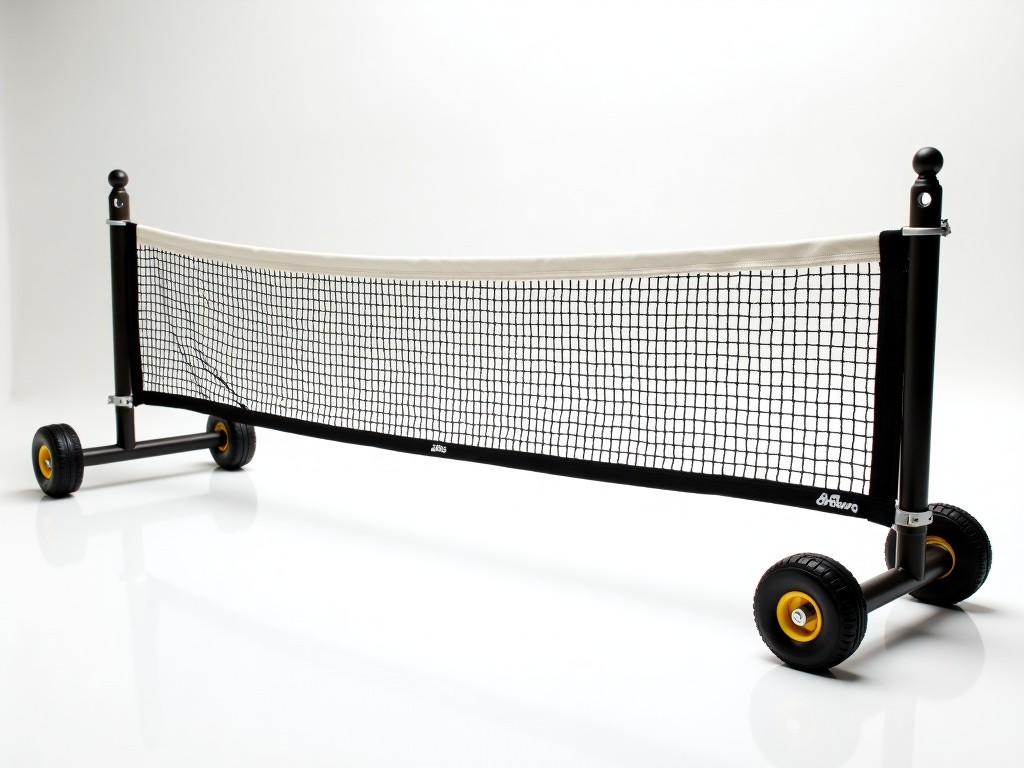
Multi-court clubs require nets with interlocking-locking mechanisms to prevent drift during rapid setup changes. Conversely, retail-focused distributors often prioritize aesthetic finishes and high-visibility colors for the net-band. We adjust the powder coating thickness and mesh density based on the projected annual exposure hours of the target facility.
Inspection Items and Test Methods
| Component | Failure Mode | Mitigation Strategy |
|---|---|---|
| Frame Joints | Stress cracking/Warping | Full-penetration weld testing |
| Net Mesh | UV Degradation/Sagging | UV-stabilized HDPE weave |
| Casters | Bearing Seizure/Locking | Sealed polyurethane bearings |
Volume Planning and Lead Time
Tooling amortisation significantly impacts the unit cost for custom-colored frame configurations. For orders under 500 units, the setup cost for specialized die-cutting and powder-coating runs is reflected in the price point. Orders exceeding 2,000 units benefit from economies of scale, reducing the per-unit cost by approximately 22%. Lead time for standard configurations is 4-6 weeks, while custom-specification hardware requires an additional 3 weeks for the validation cycle.
To discuss technical specifications or request a quote for your club facility:
Request a technical sample and bulk pricing schedule

