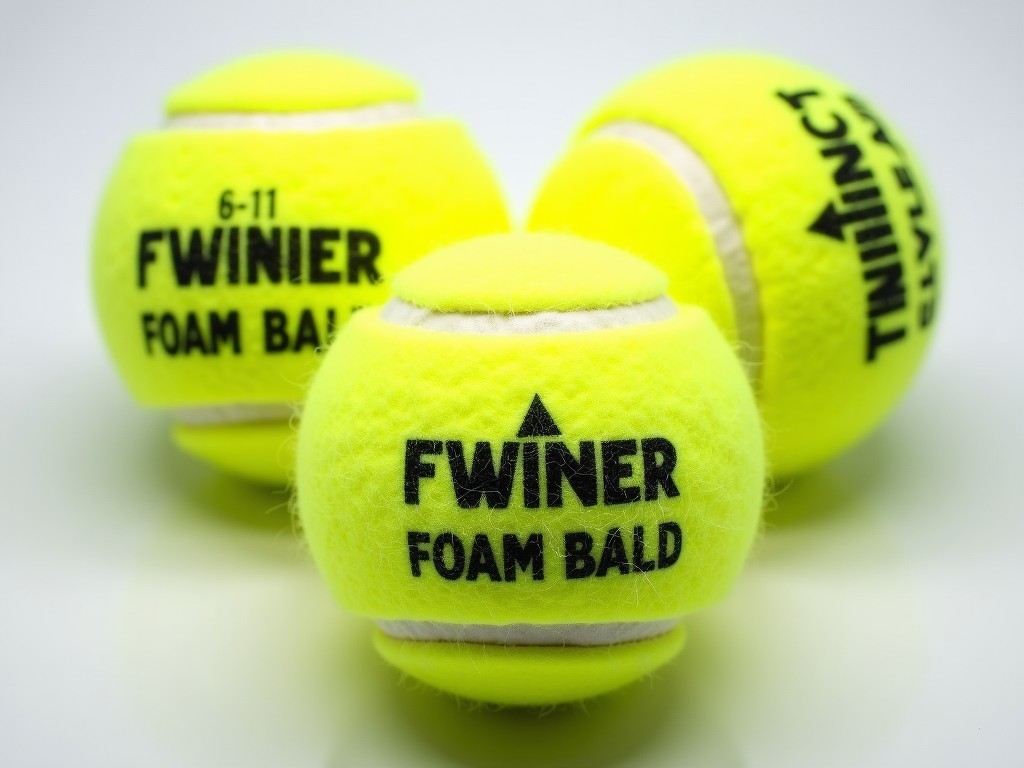
Wholesale foam tennis balls for beginners supplier: Specification, Ordering and Quality Notes
What This Product Is and Where It Fits
Beginner academies and primary school programs require equipment that priorit safety without sacrificing the mechanical feedback of a standard pressurized ball. These foam tennis balls utilize a low-density EVA core to minimize impact force, which reduces the risk of injury during early-stage hand-eye coordination. The construction allows junior players to develop swing mechanics and stroke timing without the intimidation of high speed associated with high-pressure felt balls.
Procurement officers for sports clubs often seek bulk supplies that maintain a consistent rebound height across hundreds of training hours. A uniform foam grade ensures that the ball used at the start of a session behaves identically to one at the end, which is vital for skill acquisition in de-structured learning environments.
Where Cheaper Alternatives Fall Short
Low-cost foam balls often utilize open-cell structures that suffer from rapid compression set. After repeated impacts, the internal cells lose their ability to recover, resulting in a "dead" ball that fails to bounce as expected. Furthermore, low-grade adhesives used in seam-bonding frequently lead to delamination where the outer skin peels away from the core under hard court friction.
Weight consistency is another common failure point in budget wholesale tiers. When a batch varies by more than 5-10 grams, the aerodynamic flight of the ball changes, teaching beginners incorrect swing habits to compensate for the equipment's behavior.
Technical Note: Foam Density
A density of 50-60 kg/m³ provides the optimal balance between softness and durability. Higher densities increase the weight and rebound speed, while lower densities lead to structural collapse over repeated use.
How It Is Built and What That Changes
First-article tooling determines the internal cell structure of the foam core. By using high-pressure injection molding rather than manual-cut foam blocks, we ensure that the air pockets are uniform throughout the spherical volume. This process eliminates "soft spots" that cause the ball to veer off-course upon off-center.
The outer skin is heat-welded rather than merely glued. This thermal bond creates a molecular link that withstands the shear stress of the ball hitting a hard surface at high velocities.
Where Product Beats Standard Alternatives
Standard foam balls often lack UV-stabilizing additives, leading to brittleness when stored in outdoor bins. Our formulation includes UV absorbers that prevent the polymer chains from scission due to sunlight exposure. This extends the service life of the equipment in outdoor-heavy environments by up to 40%.
The balls maintain a rebound height within a 5% tolerance when dropped from a 2-meter height, ensuring predictable drills.
The felt-overlay or smooth-skin coating prevents rapid thinning on abrasive asphalt or concrete surfaces.
Specification Range and Customisation Limits
The standard production runs accommodate various age groups and skill requirements. Most orders focus on the 65mm diameter to match standard racquet sizes, but 70mm versions are available for much younger--play groups.
| Parameter | Standard Range | Tolerance |
|---|---|---|
| Weight | 45g - 65g | +/- 3g |
| Diameter | 65mm - 70mm | +/- 1mm |
| Core Density | 50-70 kg/m³ | +/- 5% |
Customisation Options and Their Limits
Branding is applied via silk-screening or heat-transfer printing. Silk-screening is preferred for high-volume orders as the ink is less prone to cracking when the foam compresses. We are limited to 2-color prints to maintain the structural integrity of the foam surface.
For specific club branding requirements, please sample request our technical datasheet for custom artwork.
| Option | MOQ | Lead Time |
|---|---|---|
| Custom Colors | 500 units | 25-30 days |
| Logo Printing | 200 units | 15-20 days |
Inspection Items and Test Methods
Consistency is verified through standardized drop testing. Each batch is dropped from a fixed height onto a steel plate, and a digital sensor measures the peak rebound height. If the ball falls below the specified millimeter range, the batch is flagged for inconsistent foam density.
We also perform abrasion tests where the ball is vibrated against a concrete surface for a set number of cycles. This ensures the skin will not delaminate during the first month of live play.
Care, Storage and Service Life
To maintain the foam properties, balls should be stored in a climate-controlled environment. Excessive heat can cause the foam to expand and deform permanently, while extreme cold makes the material brittle. Storing balls in mesh bags prevents moisture accumulation which can degrade the adhesive bonds.


